

If you’re making a show or a film and someone told you to “get a fiscal sponsor,” you probably nodded and then googled it later. We’ve been there. Most of what’s out there reads like it was written for an accountant, so here’s the version we’d give you over coffee.
The short answer
Fiscal sponsorship lets your project borrow a nonprofit’s 501(c)(3) status. Donors give to the nonprofit, earmarked for your project. They get a tax deduction. You get the money, minus a fee. That’s really it.
It means you can tell a donor “your gift is tax-deductible” without starting a nonprofit of your own. For a lot of people, that one sentence is the difference between a maybe and a yes.
Why not just start your own nonprofit?
You can. We did, eventually. That’s what Pivotal is. But we’d be lying if we said it was quick. There’s a board, bylaws, filings every year, separate books, insurance. For one musical or one film, that’s a lot of paperwork standing between you and the actual work.
Our honest take: if you’re raising money for a single project, or you’re not sure yet whether this is a one-time thing, fiscal sponsorship is almost always the smarter first move. You can always start your own nonprofit later.
What a good fiscal sponsor actually does
A fiscal sponsor shouldn’t just take a cut and cash your checks. At a minimum, they should handle:
- Tax-deductible donations, plus the acknowledgment letters donors need at tax time
- Separate accounting, so your project’s money stays your project’s money
- A year-end financial report
That’s the list we hold ourselves to at Pivotal. If a sponsor you’re talking to doesn’t cover most of it, ask why.
The fee is where people get burned
Fiscal sponsors charge a percentage of what you raise. It sounds small until you do the math. Here’s how published fees compare.
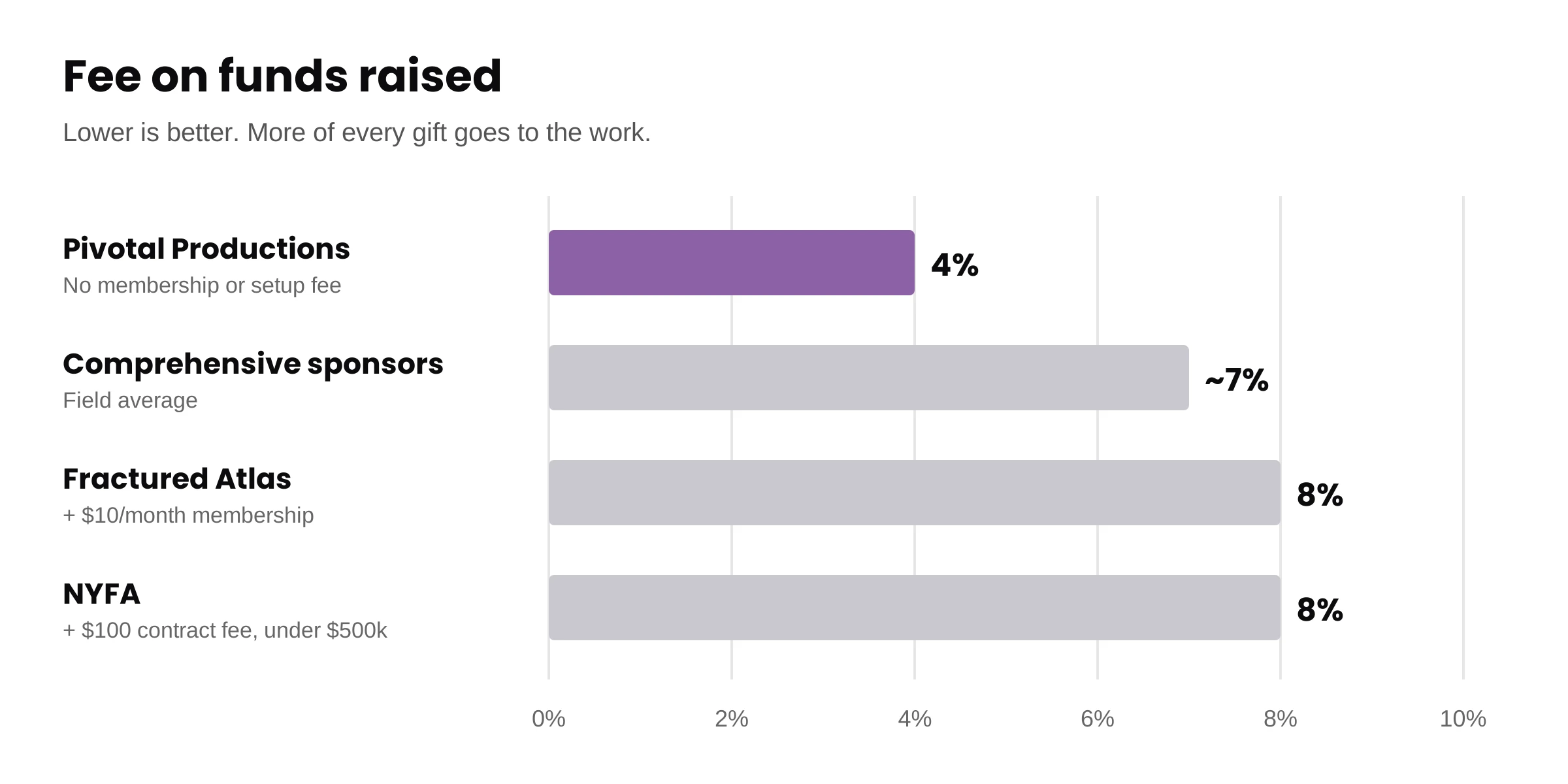
On a $25,000 raise, an 8% fee costs you $2,000. At 4% it’s $1,000. That extra thousand is a week in a rehearsal studio, a musician for your reading, or the recording you keep putting off.
- $24,000what your project keeps from $25,000 at Pivotal's 4%
- $23,000what it keeps at a typical 8%
- $0membership or setup fees at Pivotal
We set our fee at 4% on purpose. We’re artists too, and we’d rather the money go to the work.
How it works at Pivotal
- Apply. Tell us about your project in a short form.
- Talk. We get on a call to see if it's a fit and what support you need.
- Agreement. We sign a sponsorship agreement. Your materials carry the line "Fiscal sponsorship provided by Pivotal Productions, Inc." and our logo.
- Raise and build. Donors give through Pivotal, we pass the funds to your project, and we help you develop the work.
That last part matters to us. We’ve taken our own musical from first readings to an Off-Broadway run, so if you want help planning a reading or a workshop, we’re happy to get into it with you. If you just want the sponsorship, that’s completely fine too.
Is it right for your project?
It’s probably a good fit if:
- You’re raising donations, or applying for grants that require a 501(c)(3)
- You don’t have your own nonprofit (or don’t want one yet)
- Your project is a new musical or play, a reading or workshop, a film, or other new work
It’s probably not the right tool if you’re raising investment for a commercial production. Investors expect a return and donors don’t. Those are two different kinds of money with very different rules, so talk to a lawyer before you mix them.
Have a project?
Tell us about it. The application takes a few minutes, and nothing is official until we both sign.
We're artists, not lawyers or accountants, so think of this as a friendly overview rather than legal or tax advice.